
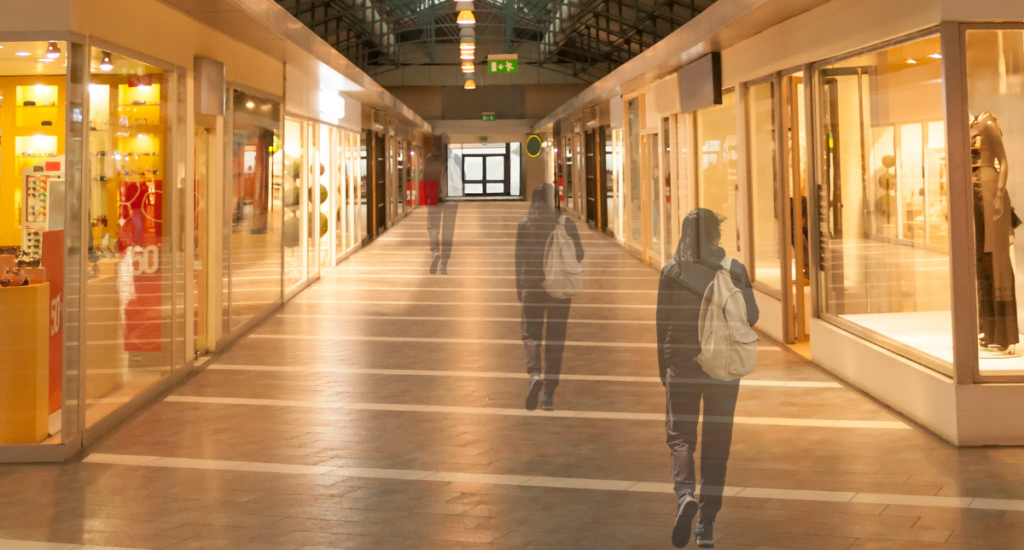
Puerto Rico: the poorest territory… with the shopping centers that sell the most per square foot. How is this structural contradiction explained?

Puerto Rico is experiencing a paradox that cannot be explained solely by traditional market indicators. Our sales per square foot in shopping malls are among the highest in the nation, but classical economic models—centered on homo economicus and rational decisions—are not enough to explain why this happens in a territory marked by emigration, poverty, aging, and deep social fragmentation.
Metrics describe the phenomenon, but do not explain its behavioral origin. To understand this, we must look at how changes in the territory reconfigured our collective psychology, our identity, and our patterns of economic behavior. The relationship between space, community and exchange in Puerto Rico is no coincidence; It is the result of a historical trajectory that shaped how we move, how we belong, and how we make decisions as a society.
Therefore, to understand the present, we must know its origin – and the historical, cultural and identity context of Puerto Rico. Only then will we be able to decipher this structural contradiction and rethink the territorial and economic future of our island.
To understand the present, we must know its origin — and the historical, cultural, and identity context of Puerto Rico
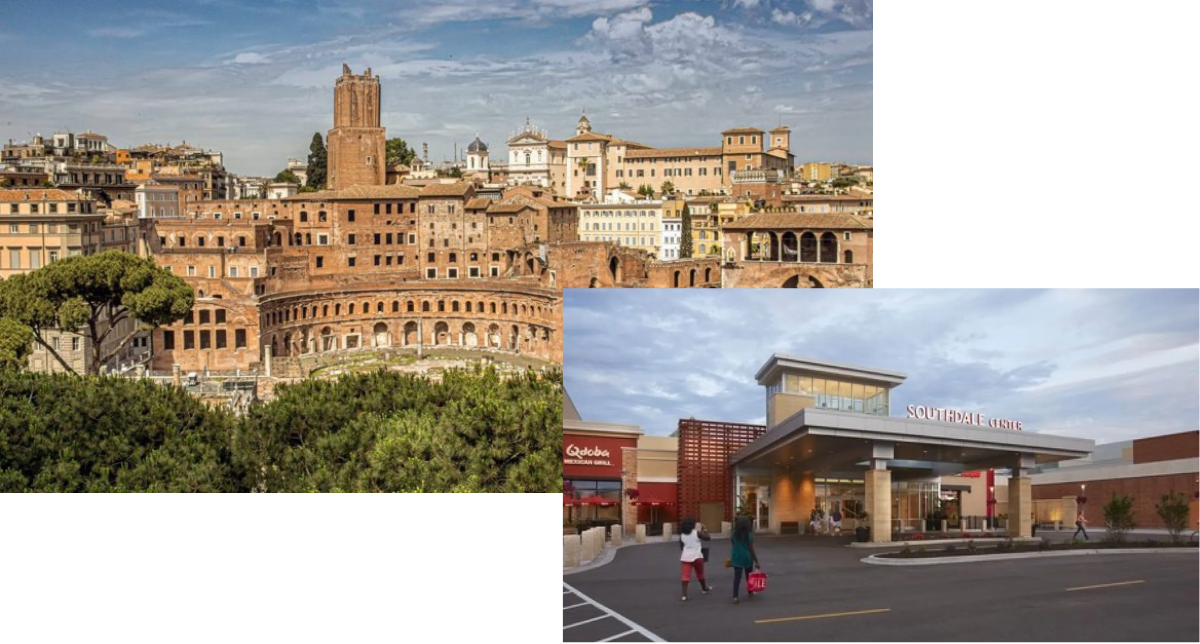
In the second century AD, Trajan’s Market in Rome became one of the world’s first integrated trading complexes. This multi-storey complex housed shops, offices, squares and pedestrian spaces within the urban heart of the city. It was not a modern “mall”: it was a market city, a structure created to coexist with public, political and cultural life.
It represented a universal principle: Trade thrives when it is integrated into human life.
Where there is a city, there is a market.
Where there is community, there is exchange.
Where there is an encounter, there is an economy.
 The American model: a break with the city
In 1956, the United States introduced the first modern shopping mall: Southdale Center, in Minnesota. Unlike Trajan’s Market, it was an isolated complex, surrounded by parking lots, designed for the car, air-conditioned and oriented to aspirational consumption rather than community life.
The American mall was not born to be integrated into the city.
It was born to replace it.
That model — not the urban, not the community, not the Mediterranean — was the one that arrived in Puerto Rico.
Puerto Rico already had a model… and it worked
Before importing the American suburb, Puerto Rico had its own, proven and functional model: the Hispanic city designed under the Law of the Indies.
This territorial system:
- organized trade around the square,
- it mixed housing, government and economy,
- promoted walkability and collective mobility,
- integrated city and countryside as a single ecosystem,
- distributed wealth,
- generated community cohesion,
- and gave cultural, economic and social structure to daily life.
In essence, Puerto Rican communities were designed so that physical space reinforced identity, community, exchange, and well-being.
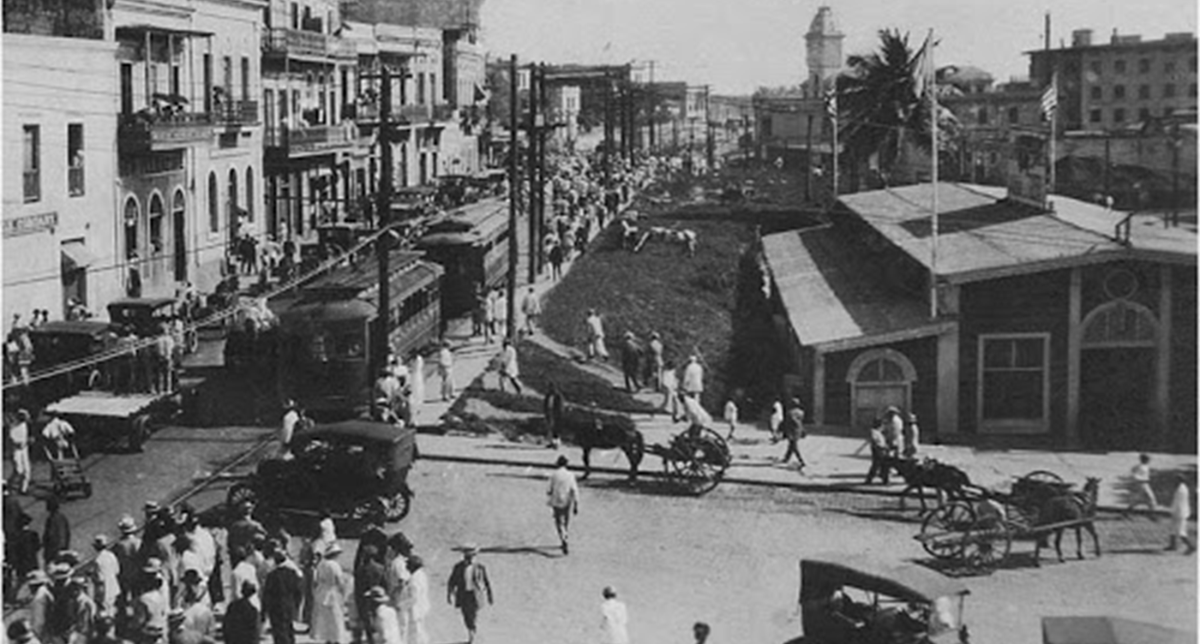
That is why, although we were not Roma, Puerto Rico had its own “Caribbean Trajans”: the Market Square of Santurce, the university-commercial ecosystem of Río Piedras, the Placita, the Ponce de León and Fernández Juncos, and the urban centers of Ponce, Caguas, Mayagüez, Arecibo, Aguadilla and Yauco.
They were modern, living, human city markets. Until they were no longer so.
When that model was weakened, Puerto Rico lost the territorial framework that gave coherence to its collective life.
1940–1970: The Transformation That Paved the Way for the Mall’s Arrival
Between 1940 and 1970, Puerto Rico underwent a profound territorial transformation.
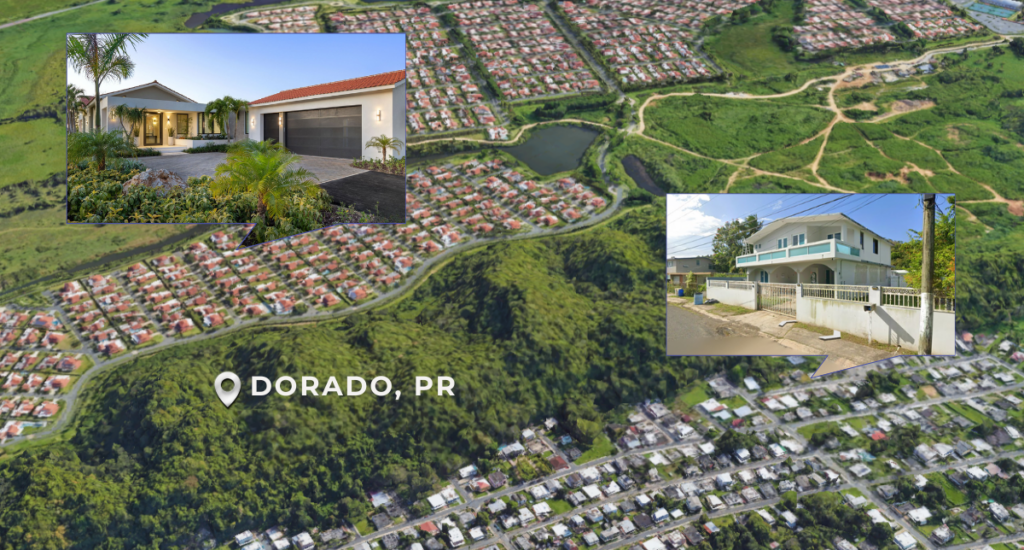
Industrialization displaced thousands to urban areas, but the urbanizations that were built – the product of a federal financing model – grew without the integral urban development that should sustain them.
FHA and suburbanization brought isolated housing estates, streets without commerce, and an absolute dependence on the car. That model fractured the human scale of Puerto Rican territory.
Law 936 generated income, but a large part of the capital was repatriated, SMEs did not grow and consumption was concentrated in megastores.
The city stopped retaining wealth.
Walkability disappeared.
The community was weakened.
The fall of urban centers was inevitable:
- Río Piedras lost autonomy in 1951,
- Santurce went into decline in the 70s,
- Ponce, Mayagüez, Caguas, Yauco, Arecibo and Aguadilla followed the pattern.
The country lost its natural spaces of encounter, commerce and belonging.
The arrival of the mall: occupation, not competition
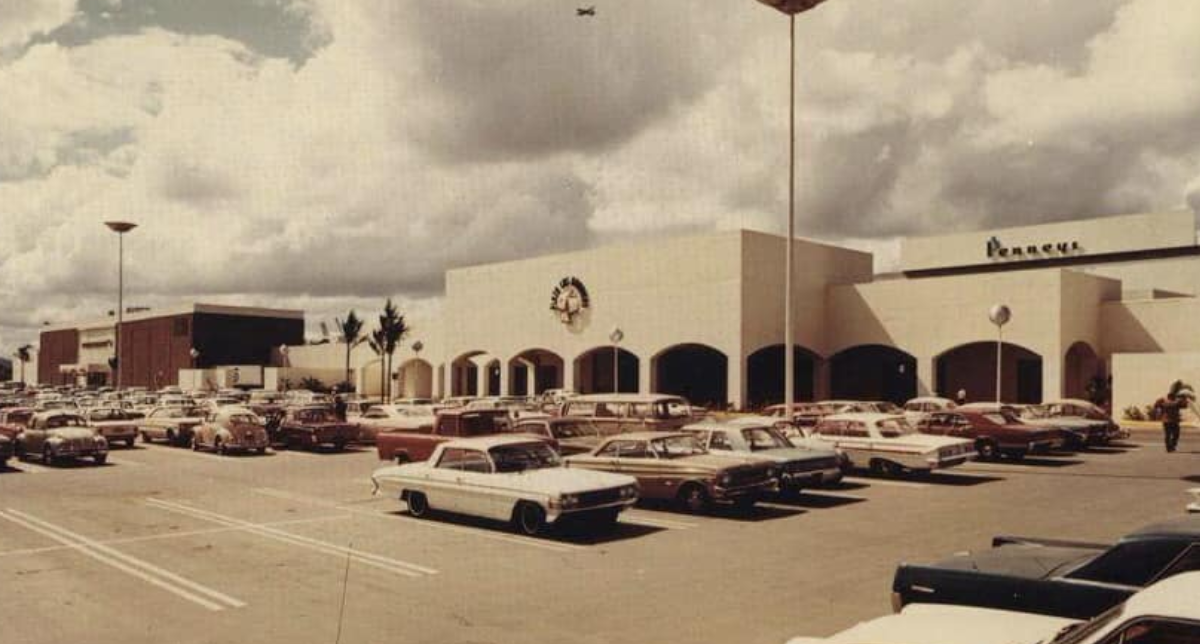
When Plaza Carolina opened in 1958 and Plaza Las Americas in 1968, they didn’t compete with the city: they replaced it.
The mall became a square, market, promenade, climate refuge, aspirational symbol, meeting point and collective room.
People didn’t just go shopping: they went because they no longer had a city.
From distributed economy to centralized economy
Megastores like Sears, Kmart, Walgreens, CVS, Payless, Borders, OfficeMax, and RadioShack absorbed the commerce that once existed scattered among thousands of small businesses.
Sales per square foot rose because trade was concentrated,
not because new wealth was generated.
Territory shapes behavior… and identity
The adult generation experienced more income, more consumption and more dependence on the mall as a symbol of belonging.
According to FINRA (2021), 39% of adults in Puerto Rico spend more than they earn. Not because of irresponsibility: because of a territory that replaced the community with consumption.
The young generation grew up in malls without identifying with them. For them, the local weighs more than the generic, the authentic more than the aspirational and the experience more than the purchase.
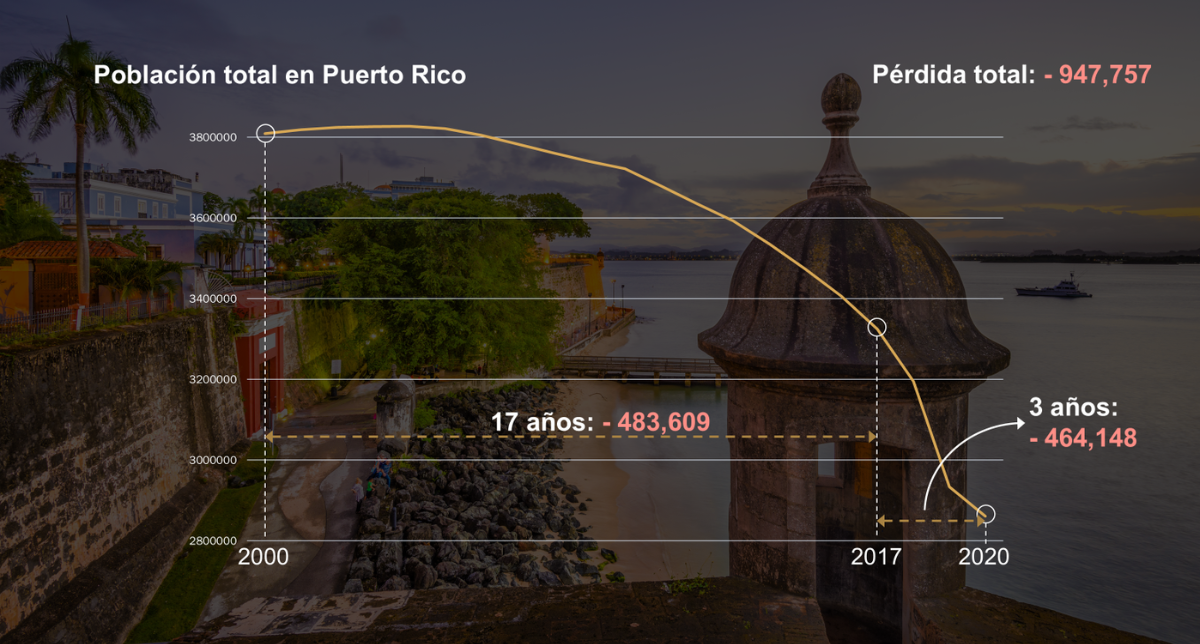
Fragmented territory → fragmented identity → fragmented country
When the urban centers were weakened, not only was the symbolic scenario of collective life extinguished: the economic and social mechanism that organized the country was dismantled.
The identity began to be diluted. It was not a sudden or superficial phenomenon: it was the psychological symptom of a territory that ceased to sustain community life.
When a people cease to see itself in its own territory, emigration becomes an emotionally viable option.
The invisible economic rupture
Much of this transformation occurred without full collective consciousness. Not because no one wanted to destroy anything, but because the value of the compact city as an economic and social system was rarely openly discussed.
It was not interpreted as strategic economic infrastructure.
And what is not named… it does not protect itself.
Thus, we adopted a fragmented model – dependent on the car, dispersed and isolated – without understanding that it was weakening our economic, emotional and territorial base.
The Alternative: Integration, Not Substitution
Urban centers can be revived as economic, residential, and social communities if they recover their natural role as the axis of the territory; and shopping centers can be strengthened if they are integrated into them.
The malls that connect to the city – through mobility, pedestrian corridors, collective transport, mixed uses and real links with the urban area – are the ones that become more resilient, less dependent on economic cycles, less vulnerable to migration and more capable of sustaining life, exchange and meaning.
Because in the end, a country is not defined only by how much it sells per square foot,
but also because of the capacity of their territory to generate belonging, stability and a shared future.
The final question
Are we ready to rebuild a Puerto Rico where urban centers and shopping centers are once again part of the same system, working together for a country that is more connected, more humane and more ours?
Respuestas