


“The reciprocity law is already a fact… now we must fine-tune it so that it is fair and benefits everyone.”

The Governor of Puerto Rico has signed the law that grants automatic recognition to occupational licenses issued in any U.S. state, with the intention of expediting labor mobility and attracting talent. This article does not question that goal; seeks to propose specific modifications to adapt the law to the needs and particularities of Puerto Rico, ensuring that the opening of the market is beneficial for all parties: local professionals, foreign professionals and the consumer public. The key lies in a distinction that the law omitted and that is fundamental to its success: not all licenses are the same. Before entering into solutions, it is important to understand where the main concerns that this law, as drafted, leaves open, lie.
Legal context and underlying concerns
- The law simplifies procedures, but applies the same treatment to professions with very different risks and regulations.
- It does not ensure that all foreign professionals receive the same basic training on operational and safety standards as the local.
- It recognizes mainland licenses, but it doesn’t correct the lack of actual reciprocity: Most states don’t automatically recognize Puerto Rican licenses.
To address these concerns, the key is to recognize a fundamental difference that does not exist today in the law and that marks the success or failure of its application.
The key distinction that the law omitted
Universal Technical Licenses (LTUs)
- Definition: Occupations based on physical principles or universal technical standards, which do not change substantially by jurisdiction.
- Examples: auto mechanics, refrigeration and A/C technicians, welders, electrical experts (when the same NEC applies), cosmetology, health professions with a valid U.S. license.
- Proposal: automatic recognition, with the obligation to take and approve the same module of law and regulations that local professionals in that occupation take, to know the operational and safety standards in Puerto Rico.
Jurisdictional Specific Licenses (LEJ)
- Definition: professions whose exercise depends on the mastery of laws, codes, culture, market, and specific practices of Puerto Rico.
- Examples: real estate broker and seller (Law 10), appraiser, civil engineer (Seismic Code), architect, lawyer and notary (civil law), licensed professional planner.
- Proposal: pass the same module as the premises and, depending on the risk and nature of the profession, the regulatory board may require an exam or complementary internship.
Supporters of total openness often rely on widely cited studies, but on closer analysis we find that they do not always reflect the complexity of our context.
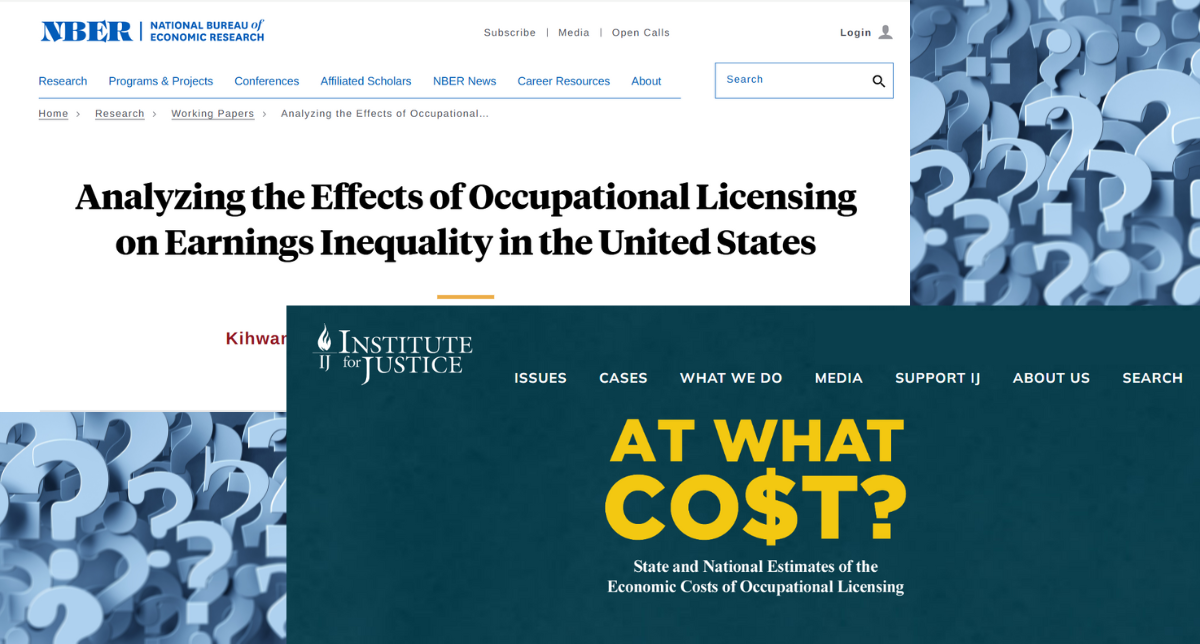
Most cited studies and their limitations
- Institute for Justice – At What Cost?
- It estimates that occupational licenses cost 2 million jobs and $184 billion annually in “economic loss.”
- Limitations: it does not distinguish between LTU and LEJ, mixes low- and high-risk occupations, does not analyze reciprocity or mobility, ignores non-monetary benefits, and does not contextualize for island economies.
- NBER Working Paper No. 33732 (Bae et al., mayo 2025)
- It analyzes the “license premium” between 1983 and 2019 and concludes that it grew modestly, especially in high-paying occupations.
- Limitations: does not accurately quantify in dollars or percentage points, does not distinguish between LTU and LEJ, does not verify whether workers are actually licensed, does not address reciprocity or non-monetary benefits.
Beyond the specific limitations of each, both share gaps that prevent a fair evaluation adapted to the reality of Puerto Rico
Common shortcomings of both studies
- No LTU/LEJ classification.
- Aggregate approach that dilutes differences in risk and regulation.
- Lack of data on reciprocity and professional mobility.
- Omission of non-monetary benefits (security, trust, quality).
- They do not adapt conclusions to island contexts such as Puerto Rico.
If we aspire to a law that combines agility and security, we need a more precise legislative framework that starts from this fundamental distinction.
Legislative route for smart reciprocity
- Official LTU/LEJ classification in law.
- LTU: automatic recognition + mandatory module of law and regulation equal to the one taken by the premises.
- LEJ: mandatory module + option for the regulatory board to require an exam or internship according to risk.
- Annual public list with classification and requirements by occupation.
- Bilateral negotiation to achieve real reciprocity with other jurisdictions.
- Periodic review to reclassify licenses according to regulatory and technological changes.
Ultimately, the aim is not to curb labour mobility, but to ensure that this opening is beneficial, safe and competitive for all sectors.

Conclusion
The opening of the market sought by the law is an important step, but it confuses agility with the absence of filters. Not all licenses are created equal: some can be transferred almost frictionlessly, others require in-depth knowledge of the local framework to protect the consumer and ensure quality. The distinction between Universal Technical Licenses and Jurisdictional Specific Licenses is the tool that Puerto Rico needs for reciprocity to be fair, safe, and competitive.
The opposition expressed by multiple professional associations, guilds and associations should not be ignored. Neglecting these voices—which represent practical knowledge and daily experience—can be interpreted as a case of epistemic injustice, where the knowledge of those on the front lines of these professions is marginalized. A truly effective law must listen, integrate, and balance all perspectives to serve the public interest.





Respuestas